
| LM | Inheritance in Object-Oriented Programming |
Inheritance is a fundamental concept in object-oriented programming (OOP).
It allows one class to inherit attributes and methods from another class.
- The existing class is called the parent class (or base class).
- The new class is called the child class (or subclass).
Inheritance models an “is-a” relationship:
A Car is a Vehicle
A Truck is a Vehicle
Why do we use inheritance?
Inheritance helps to:
- avoid code duplication
- reuse existing functionality
- create logical class hierarchies
- extend behavior in a controlled and structured way
Common functionality is placed in a parent class and reused by child classes.
How inheritance is defined in Python
In Python, inheritance is defined by passing the parent class name in parentheses:
class ChildClass(ParentClass):
    pass
This tells Python that ChildClass inherits all public attributes and methods from ParentClass.
Example: Vehicle, Car, and Truck
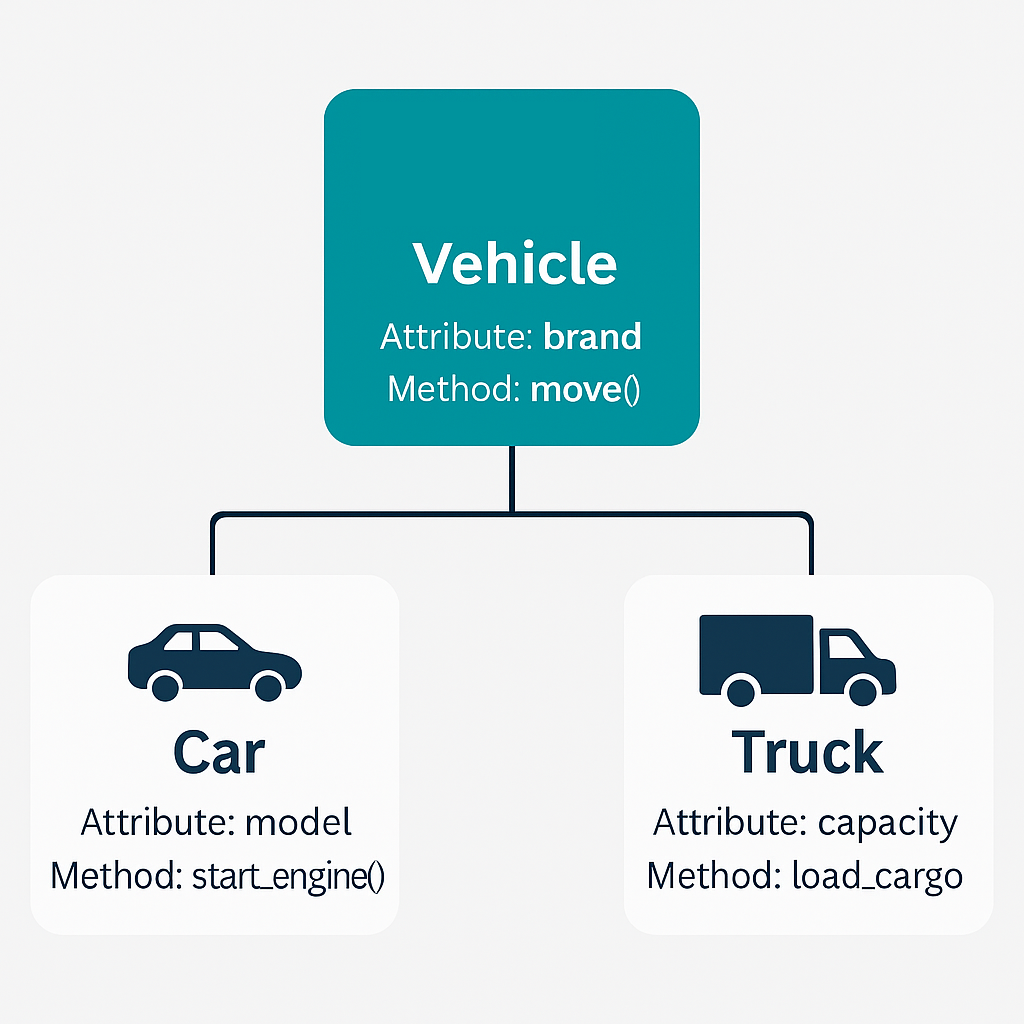
We start with a general base class called Vehicle.
class Vehicle:
    def __init__(self, brand):
        self.brand = brand

    def move(self):
        print(f"The {self.brand} vehicle is moving.")
The Vehicle class defines:
- a shared attribute:
brand - a shared method:
move()
Child class: Car
The Car class inherits from Vehicle and adds its own attributes and behavior.
class Car(Vehicle):
    def __init__(self, brand, model):
        super().__init__(brand)
        self.model = model

    def start_engine(self):
        print(f"The {self.brand} {self.model}'s engine has started.")
Important points:
class Car(Vehicle)defines inheritancesuper().__init__(brand)calls the parent constructorCarautomatically inheritsbrandandmove()
Child class: Truck
class Truck(Vehicle):
    def __init__(self, brand, capacity):
        super().__init__(brand)
        self.capacity = capacity

    def load_cargo(self):
        print(f"The {self.brand} truck is loading {self.capacity} tons of cargo.")
Both Car and Truck reuse functionality from Vehicle and extend it with specialized behavior.
Why is super() important?
The super() function allows a child class to access methods from its parent class.
In constructors, super() ensures that:
- shared attributes are initialized correctly
- parent logic is reused
- code duplication is avoided
Without super(), parent logic would need to be rewritten manually.
Using inherited classes
my_car = Car("Toyota", "Corolla")
my_truck = Truck("Mercedes", 10)

my_car.move()
my_car.start_engine()

my_truck.move()
my_truck.load_cargo()
Output
- The Toyota vehicle is moving.
- The Toyota Corolla’s engine has started.
- The Mercedes vehicle is moving.
- The Mercedes truck is loading 10 tons of cargo.
Key concept: Method inheritance
Even though Car and Truck do not define move() themselves,
they can still use it because it is inherited from Vehicle.
Summary
- Inheritance creates an is-a relationship between classes
- Child classes inherit attributes and methods from parent classes
- In Python, inheritance is defined using
class Child(Parent) super()is used to access parent class methods- Inheritance improves code reuse, structure, and clarity