Example: Visual Data Exploration
Visual exploration starts with a question and an understanding of the observations. Here, each row is one German federal state in 2024. We use the prepared Destatis land-use file generated in the CSV I/O example. That page documents the source table, English names, numeric conversion, and exclusion of Germany’s aggregate. The RDS is a saved result of that preparation, not an independent data source.
If you completed the CSV I/O example, the RDS is already in your project’s Data/ folder. Otherwise, download the prepared file linked above and save it there. All six land-use measurements are percentages of each state’s total area; Area_ha separately records total area in hectares. The following four columns describe non-overlapping categories, but do not cover every land use. Settlement excludes transport under this source’s classification.
lu <- readRDS("Data/destatis-land-use-2024-states.rds")
numc <- c("Settlement", "Transport", "Agriculture", "Forest")
head(lu[, c("Year", "ID", "Place", numc)])
##   Year ID                  Place Settlement Transport Agriculture Forest
## 1 2024 01     Schleswig-Holstein        9.4       4.4        68.1   10.3
## 2 2024 02                Hamburg       46.3      12.4        22.7    5.6
## 3 2024 03           Lower Saxony        9.5       5.2        57.7   21.7
## 4 2024 04                 Bremen       44.0      12.3        26.8    1.4
## 5 2024 05 North Rhine-Westphalia       16.9       7.1        46.6   24.8
## 6 2024 06                  Hesse        9.5       6.7        41.1   40.1
First numerical overview
Before plotting, inspect the ranges and typical values:
summary(lu[, numc])
##    Settlement      Transport       Agriculture        Forest
##  Min.   : 5.60   Min.   : 3.100   Min.   : 4.00   Min.   : 1.40
##  1st Qu.: 7.85   1st Qu.: 4.400   1st Qu.:40.12   1st Qu.:20.40
##  Median : 9.50   Median : 5.400   Median :46.30   Median :25.80
##  Mean   :17.01   Mean   : 6.569   Mean   :44.49   Mean   :25.61
##  3rd Qu.:15.93   3rd Qu.: 6.800   3rd Qu.:54.62   3rd Qu.:35.33
##  Max.   :55.90   Max.   :14.700   Max.   :68.10   Max.   :40.50
For each numerical column, summary() reports the minimum, first quartile, median, mean, third quartile, and maximum. The three quartiles mark the boundaries of four approximately equal parts of the ordered observations. The median is the middle value, or the mean of the two middle values for an even number of observations. The mean uses every value and is more sensitive to extreme observations. These summaries give each of the 16 states equal weight; they are not Germany’s area-weighted percentages.
Bar charts: compare named observations
Suppose the question is: How do selected land-use shares compare between Lower Saxony, Hesse, and Bavaria? Select those states by their stable identifiers, then compare the four categories with grouped bars:
selected <- lu[match(c("03", "06", "09"), lu$ID), ]
heights <- t(as.matrix(selected[, numc]))
barplot(heights, beside = TRUE,
        names.arg = c("Lower Saxony", "Hesse", "Bavaria"),
        col = c("steelblue", "darkorange", "goldenrod2", "darkgreen"),
        ylim = c(0, max(heights) * 1.4),
        ylab = "Share of state area (%)", main = "Land use, 2024",
        legend.text = numc,
        args.legend = list(x = "topright", ncol = 2, bty = "n"))
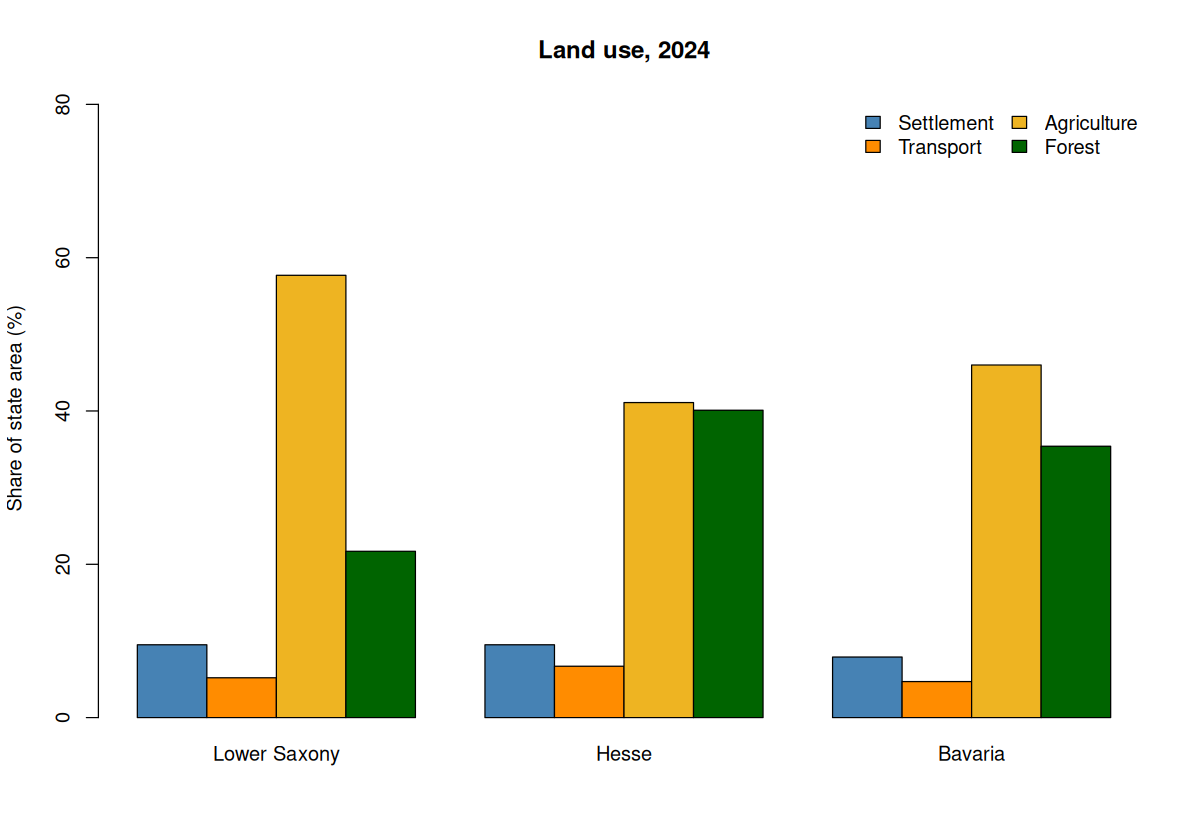
match() locates the requested state IDs in the specified order, and as.matrix() converts the selected numerical columns to a matrix. barplot() uses the matrix values as bar heights. Transposing with t() puts categories in rows and states in columns; beside = TRUE places category bars next to each other within each state. The bars start at zero, and the labels and legend identify the percentages and groups.
This figure shows a value for each named category in each selected state. A boxplot instead answers how the values are distributed across all 16 states; a histogram groups numerical values into intervals. The Base R bar-chart page provides additional examples.
Boxplot
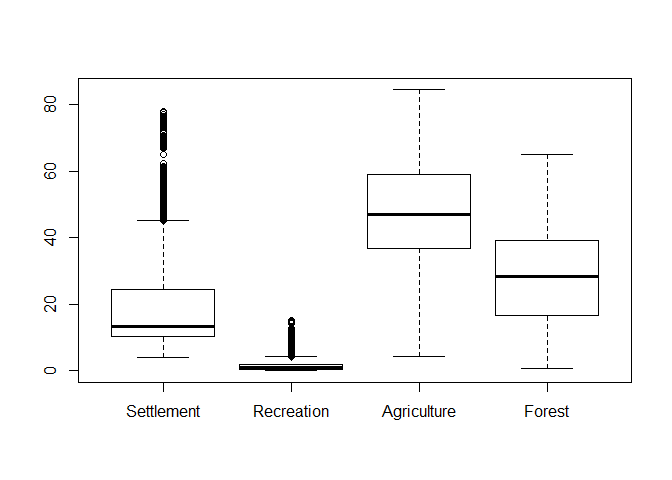
A boxplot summarizes the center and spread of a distribution. The line inside the box marks the median. R places the box edges at lower and upper hinges, which approximate the first and third quartiles and can differ slightly from the values printed by summary(). The whiskers extend to the most extreme observed values within 1.5 box lengths of the box edges. More distant values are plotted individually; this rule flags values to inspect, not errors to delete automatically. See the R boxplot documentation for the calculation.
Producing a boxplot is straightforward (the x-axis labels are just the column names):
boxplot(lu[, numc], ylab = "Share of state area (%)")
Histograms
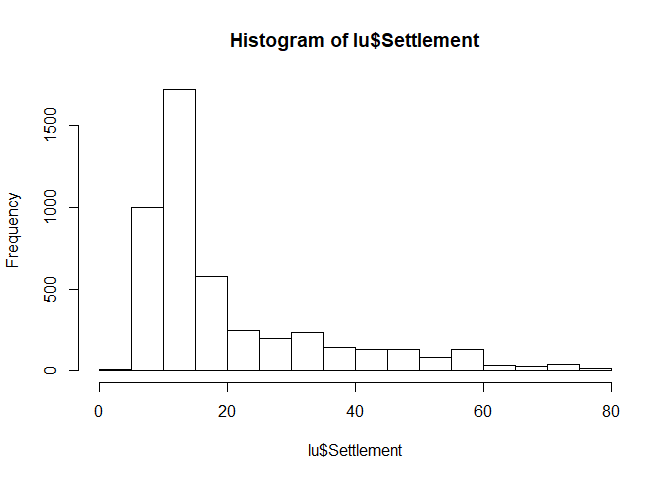
A histogram shows how many observations fall within each numerical interval. Here the horizontal axis shows settlement shares and the vertical axis counts states. With only 16 observations, the apparent shape can depend strongly on the interval boundaries:
hist(lu$Settlement, main = "Settlement shares across 16 states",
     xlab = "Settlement share (%)", ylab = "Number of states")
Scatterplot
A scatterplot shows paired values for the same observations. Here, each point represents one state. We compare settlement and transport shares; placing a variable on the horizontal axis does not establish it as a cause of the vertical-axis variable.
Pass the two numerical columns to plot():
plot(lu$Settlement, lu$Transport,
     xlab = "Settlement share (%)", ylab = "Transport share (%)", pch = 16)
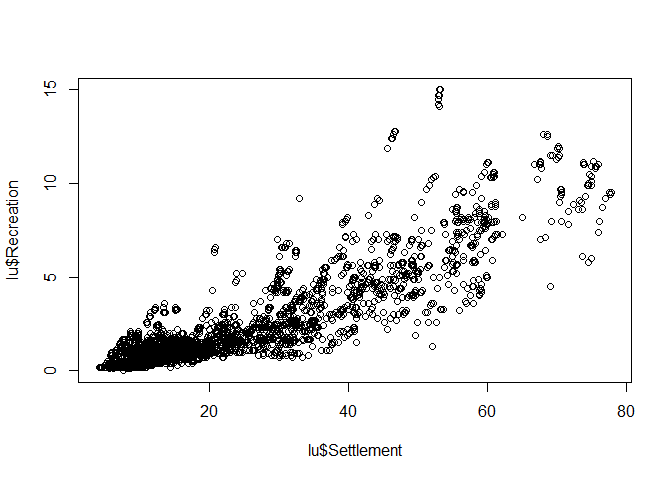
Read the figures alongside the summary: the settlement mean (17.01%) exceeds its median (9.50%), consistent with a few states having much higher shares.
Even an exploratory graph benefits from variable names and units. City-states and larger states can occupy different parts of the plot. Investigate the reporting areas before interpreting an unusual point as an error or a general relationship.
Arrange four plots in one figure
For a 2×2 figure, par(mfrow = c(2, 2)) creates two rows and two columns. Each new high-level plotting call, such as plot(), hist() or boxplot(), fills the next panel, moving across each row:
1: top left       2: top right
3: bottom left    4: bottom right
Use the following layout template with your own four plotting commands in place of the comments:
old_par <- par(no.readonly = TRUE)
par(mfrow = c(2, 2))
# First plotting command
# Second plotting command
# Third plotting command
# Fourth plotting command
par(old_par)
Saving the original settings before changing them lets you restore them afterward. A call such as lines() adds to the current plot; it does not start another panel. Replace the four comment lines with your own plotting calls when using this template for Assignment 03.
Continue with Assignment 03
The import, basic plot types and four-panel layout prepare you for Assignment 03: Read and Plot. Use the line-chart example when plotting the timber harvest over time.